

 Wellness Essentials
 Neck Care Essentials
 Terahertz Tech Series
 Beauty & Personal Care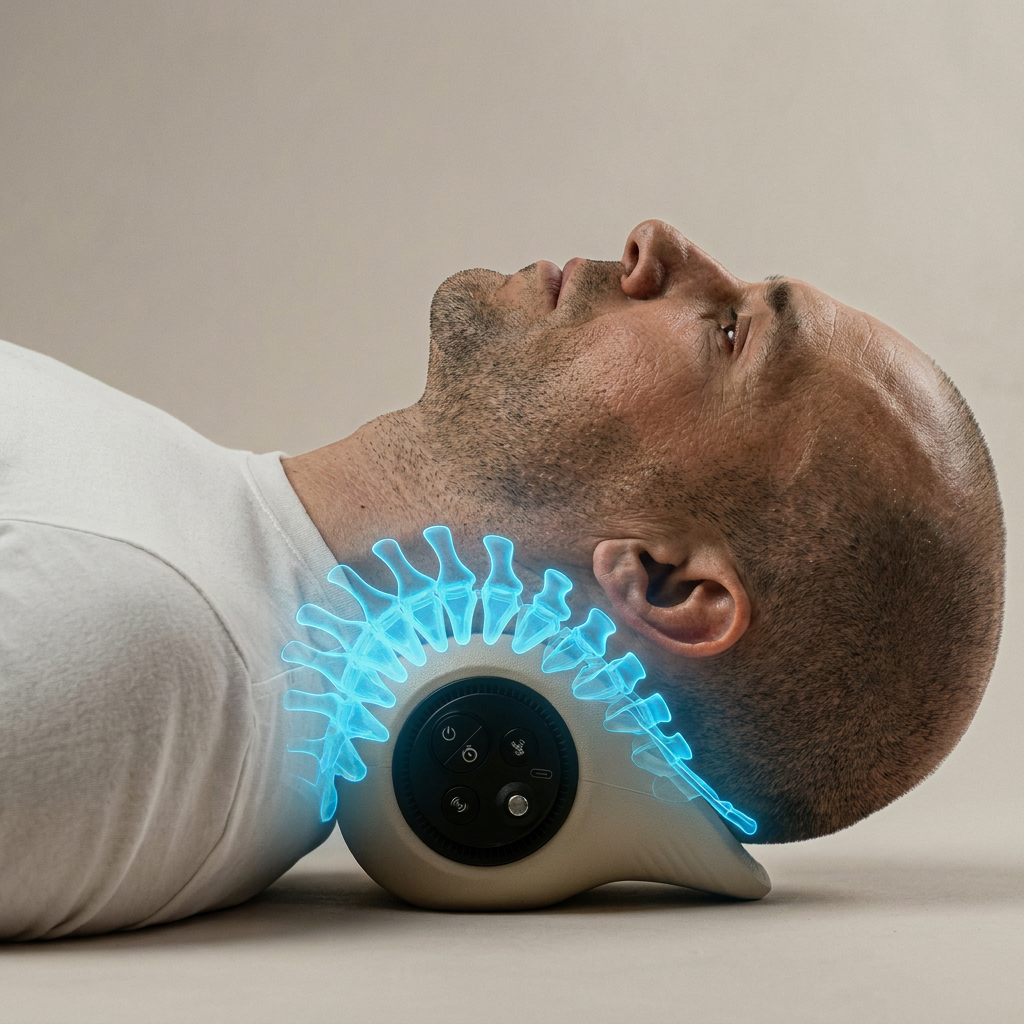
What traction is actually doing
Cervical traction has one job: create and hold a small amount of space between the vertebrae so the soft tissue around them can lengthen and the structures between them stop being compressed.
The operative word is hold. Decompression isn't an event, it's a duration. You need a steady, boring, unchanging pull for several minutes so the muscles around your cervical spine stop guarding and let the load through.
That last part is the whole game. Your neck muscles are protective by default. If they're bracing, the pull lands on contracted muscle instead of reaching the joints and discs underneath. Everything about a good traction session is designed to convince those muscles that nothing threatening is happening, so they let go.
Which brings us to the vibration motor.

Vibration tells muscles to switch on, not off
Inside your muscles are stretch receptors called muscle spindles. Their job is to report length and rate of change — am I being stretched, and how fast?
Muscle spindles are extremely sensitive to vibration. It's not a subtle relationship; vibration is close to the perfect stimulus for them. Apply it to a muscle and the spindle fires as though the muscle is being stretched, and the spinal cord responds the way it always responds to a stretch: by contracting the muscle. This is a documented reflex, and it doesn't require your permission.
So during a vibrating traction session, two contradictory instructions are running at the same time:
- The pull is asking the muscle to lengthen and stay long.
- The vibration is telling the spinal cord that muscle is being stretched, prompting it to contract.
You're pulling and bracing simultaneously. At best that means less of your traction force reaches the joints. At worst you finish the session with the deep cervical muscles more tonic than when you started — which is the exact opposite of the thing you sat down to do.
Vibration also drowns out your position sense
There's a second problem, and this is where the research gets interesting.
Vibration and proprioception — your sense of where your body is in space without looking — travel to the brain along the same route. Same spinal pathway, same relay stations. That shared wiring is why vibration doesn't just sit alongside position sense; it competes with it.
The effect has been measured directly. In a 2018 study published in the Journal of the Canadian Chiropractic Association, researchers fitted 21 healthy, pain-free adults with a helmet-mounted laser pointer aimed at a target chart. Eyes closed, each participant moved their head to end range and returned to what felt like neutral. The laser recorded how far off they actually were.
Then they repeated it with vibration running.
The errors got significantly bigger. In five of the six neck movements tested — extension, both rotations, both side bends — participants were measurably worse at finding neutral once vibration was introduced, and the effect held up statistically after ruling out fatigue and practice. Most of the misses were overshoots: people went past neutral without knowing it.
Worth noting the vibration was set to 20 Hz, the lowest setting the platform offered. This wasn't an extreme stimulus. It was the gentlest one available, in healthy young adults, with no neck complaints at all.
Why that matters specifically during a traction session
Being slightly off on a laser target doesn't sound alarming on its own. It matters here because of the conditions traction happens in.
You're sitting still with your neck under sustained load. Your eyes are usually closed. There's no mirror, no coach, nobody checking your alignment. Every input you have about where your head is and how much pull is too much is coming from proprioception and sensation — and vibration degrades the first one while masking the second.
Vibration is also a well-known counter-irritant. It damps down what you can feel in the area, which is exactly why it feels pleasant. But during traction, sensation is your dosing instrument. It's how you know the pull is right, how you know to stop, how you know you've drifted out of neutral. Numbing that channel while a load is applied removes the feedback the session depends on.
Put plainly: vibration makes the session feel better while making you less able to judge whether it is better.
To be fair about the evidence
We'd rather you trust us than oversell this, so: that study was a pilot with 21 people, it used a whole-body vibration platform rather than a vibrating collar, and it didn't test traction at all. It measured head repositioning accuracy, not injury. Other research on vibration and neck function has found benefits in some contexts, particularly as a standalone training input.
Nobody has proven that vibrating during traction hurts people. What we're saying is narrower and, we think, harder to argue with: the two are asking your nervous system for opposite responses, and there's measured evidence that vibration degrades neck position sense in the exact window you'd be relying on it.
Given that, stacking them into one session is a design shortcut that sells units. It isn't a treatment rationale.
What to do instead
If your device has vibration, you don't have to throw it away — just stop running it concurrently.
Sequence them:
- Vibration or heat first, 3–5 minutes, no traction. Use it as a warm-up. This is where it genuinely earns its place — increasing local circulation and reducing surface tension in the upper traps and posterior neck before you load anything.
- Then traction, on its own. Steady, held, unchanging. Let the tissue lengthen without competing signals.
- Sit still for a minute afterward before standing. Position sense recalibrates faster than you'd think, but give it the minute.
Rules of thumb:
- Never increase traction force while vibration is running. You can't accurately feel what you're doing.
- If you feel dizzy, foggy, or unsteady during or right after a session, stop. That's a proprioceptive mismatch, not progress.
- Boring is correct. If a session needs a buzz to feel worthwhile, the pull probably isn't set right.
That last one is the summary of this whole article. A traction session should feel uneventful. The results show up afterward, in how your neck moves the next morning — not in how stimulating the ten minutes felt.
It's why our devices do one thing during the pull, and do it steadily.

This article is general information about how these devices work, not medical advice. If you have a diagnosed cervical condition, a history of neck injury, or symptoms that radiate into your arms or hands, talk to a clinician before starting any traction protocol.
Source: Morley J, Sikorski DM. Effect of whole body vibration on cervical (neck) proprioception in young, healthy individuals serving as their own control: a pilot study. J Can Chiropr Assoc. 2018;62(1):42–55.
Share:
Understanding Tech Neck: Causes, Symptoms, and Solutions